Feature
You are already on page one for questions you are not answering
Google pulls a featured snippet from a result that is usually already on page one. So the pages closest to winning the answer box are pages you already own, sitting at position four or six, losing the click to a box above them. Flowra finds them and ranks them by what the box is worth.
The short answer
A featured snippet is the answer box at the top of Google's results, and Google almost always fills it from a page already ranking on page one. That makes it the rare SEO win that does not require out-ranking anybody: a clearer, shorter, better structured answer can take the box from position six. Flowra reads your Search Console data, keeps the queries shaped like a question or a comparison, keeps the ones where you already rank between positions two and eight, and ranks what is left by how many clicks winning the box would be worth.
What you see
A shortlist, in the order worth doing
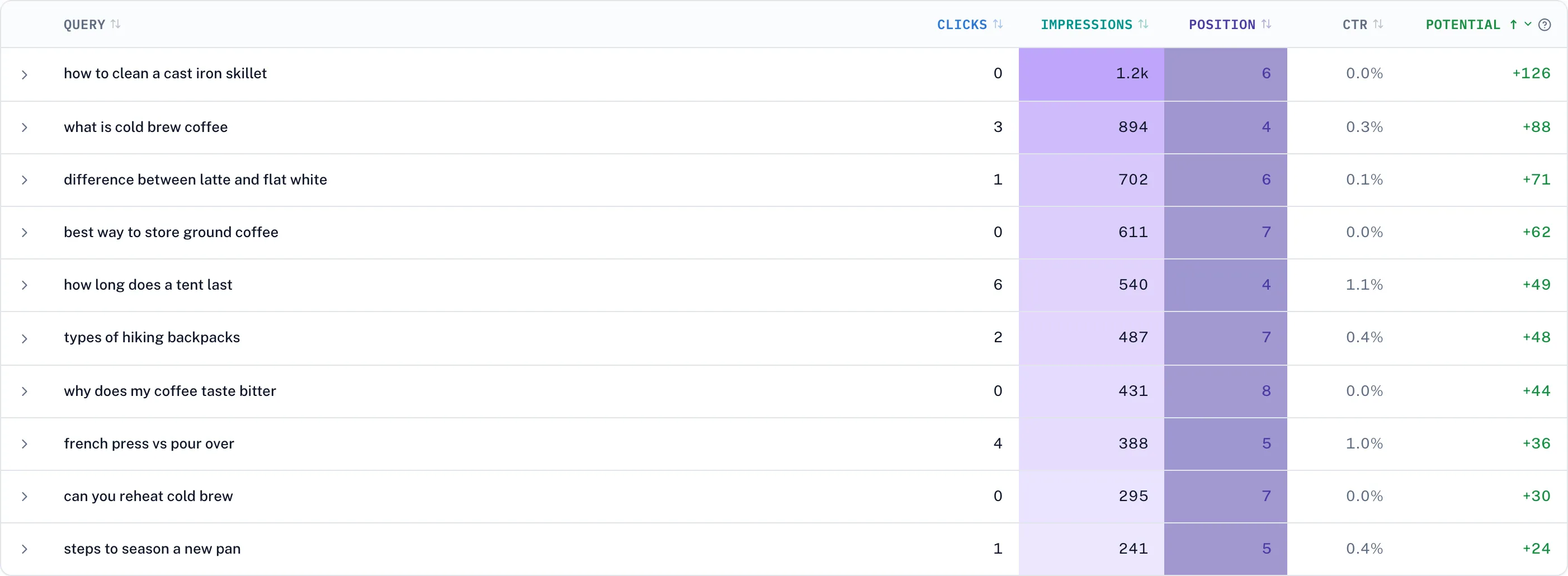
One row per opportunity. The query, where you currently rank for it, how many times you were shown, how many of those turned into a click, and what the answer box is estimated to be worth if you win it.
The rows that matter most are the ones with high impressions and almost no clicks. That combination means Google is showing you the query constantly and almost nobody is choosing you, which is what a snippet sitting above you looks like from your side of the screen.
The three gates
Why the list is short, and why that is the point
A report that hands you four hundred opportunities has not helped you. Three filters run in order, and each one exists to throw away work that would not pay.
Positions two to eight
Google builds the box from page one, so anything on page two is not a snippet opportunity, it is a ranking problem. Position one is excluded for the opposite reason: if you are already first and there is a box, it is usually yours. You can move both ends of this range on screen when you want to look wider.
Shaped like a question or a comparison
Snippets answer questions, compare two things, or list types of something. A query like "nike running shoes" will never get a paragraph box no matter how well you write, because Google answers shopping with products.
At least three impressions
A query you were shown twice is noise. This is a deliberately low floor rather than a high one, because a question with modest volume and a winnable box is still a real opportunity.
The hard part
Search Console deletes the question mark, so the shape has to be inferred
The obvious way to find question queries is to look for a question mark. It does not work, because Search Console strips punctuation from every query it reports. Somebody types "how do I season a cast iron pan?" and it reaches you as "how do i season a cast iron pan". The single most reliable signal is gone before you see the data.
So the shape has to be read from the words. Two lists do it: the words a question opens with, and the phrases that make a query snippet-shaped without being a question at all. The second list is the one most tools skip, and it is where the easiest wins live, because comparison snippets are among the most winnable there are.
Counted
- how to clean a cast iron skilletStarts with a question word
- difference between latte and flat whiteA comparison, the most winnable snippet there is
- french press vs pour overAlso a comparison, written the short way
- types of hiking backpacksA list, which Google answers with a bulleted snippet
- best way to store ground coffeeA method question without a question word
Deliberately not counted
- may camping deals"may" is a month far more often than it is a question
- isopropyl alcoholStarts with the letters of "is" and asks nothing
- vsco filtersContains the letters of "vs" and compares nothing
- nike running shoesShopping. Google answers this with products, not a paragraph
Those last three are not hypothetical. Matching "is" at the start of a query catches "isopropyl alcohol". Matching "vs" anywhere catches "vsco filters". Matching "may" catches every seasonal shopping query in spring. Each of them had to be handled deliberately, and "may" is left out of the list entirely on the grounds that it is a month far more often than it is a question.
The ordering
Ranked by clicks available, not by how close you are
Sorting by position would put your position-two queries first, which is backwards. Position two on a query nobody searches is worth nothing. Position seven on a question you are shown twelve hundred times a month is worth a great deal.
So each row is scored by the gap between the clicks you get now and the clicks a top-three result typically gets at that impression volume, using published click-through averages by position. That produces the Potential column, and it is what the list sorts by.
Two honest caveats about that number. It is a blended industry average, not your site's own curve, so treat it as an order of magnitude and a ranking rather than a forecast. And it measures the value of reaching the top three, which is the closest stable proxy available, because nobody publishes reliable click-through rates for the answer box itself.
The same scoring model runs behind Striking Distance, deliberately, so a number in one report means the same thing as a number in the other and you can compare an opportunity across both.
What to change
Forty to sixty words, directly under the right heading
Winning a snippet is a formatting job far more often than a writing job. The page usually already contains the answer. It is just buried in the fourth paragraph of a section, wrapped in context, phrased conversationally, and impossible for Google to lift cleanly.
The fix is nearly always the same shape. Give the page a heading that matches the query closely. Put the answer immediately under it, in forty to sixty words, or as a numbered list if the query is a process, or as a bulleted list if the query is asking for types. Then carry on with the detail underneath, because the snippet is not the article, it is the door into it.
Repeat the query's own wording in the heading. Not stuffed, just present. Google is matching a question to a passage, and a heading that reads like the question is the clearest possible signal that the passage under it is the answer.
The thing to resist is rewriting the whole page. You already rank on page one, so the page is working. A full rewrite risks the ranking you have in pursuit of a box you might not win.
Do it yourself
How to find these in Search Console by hand
The data is yours and it is already in your account. Here is the manual route, both because it works and because you should be able to check any tool's answer against your own.
- 1Open Search Console, go to Performance, then Search results, and set the range to the last three months.
- 2Turn on the Average position and Average CTR columns as well as clicks and impressions. All four have to be visible.
- 3Open the Queries tab and export to Google Sheets. The interface cannot filter on two numeric columns at once, so the sheet is not optional.
- 4Filter to rows where average position is between 2 and 8.
- 5Filter again to rows where impressions are meaningful and clicks are near zero. That pair is the signal.
- 6Read down what is left and keep only the queries that ask something, compare two things, or ask for types of something.
- 7For each survivor, open the page that ranks for it and check whether there is a heading matching the query with a short answer directly under it. Usually there is not. That is the job.
Step six is the one that does not survive contact with a real site. Reading a few thousand queries and judging each one's shape by eye is an afternoon, and you will have to do it again next month, and your judgement will drift.
What Flowra does is the same job, on every refresh, with the shape rule written down instead of remembered. The data is not secret. The value is not doing this again.
Frequently Asked Questions
Featured snippet opportunities
Related
- Content decay, for pages that are losing what they already had rather than reaching for more.
- Traffic from AI assistants, because the structure that wins a snippet is the structure assistants quote.
- Every Flowra feature, including striking distance, cannibalization and the rework queue.
- Pricing, including which plans include the full analytics dashboard.
See which answer boxes are within reach
Connect Search Console and get the shortlist from your own data. Free to start, no card needed.
Start free